Essential Media Server Hardware Acceleration Guide for Smooth Streaming
If you run a home media server, enabling media server hardware acceleration is the single biggest performance upgrade you can make. Whether you use Jellyfin or Plex, offloading…
grep -r "#tag"
If you run a home media server, enabling media server hardware acceleration is the single biggest performance upgrade you can make. Whether you use Jellyfin or Plex, offloading…
How Stashboard v7.6 and v7.7 turn risky stack edits into a safe Docker Compose edit diff apply workflow — unified diff, dry-run validation, apply-only-changed services, revision history, a dependency graph, and an inline linter.
If you’re running a home server, a solid NAS backup and restore strategy is not optional — it’s what separates a recoverable incident from a catastrophic, unrecoverable data…
Edit the docker compose resource limits ui in Stashboard: per-service CPU/RAM caps plus top-level networks, volumes & secrets. Deep self-hosted how-to.
Self-hosted docker compose templates in Stashboard V7.5: over 125 starter recipes across 10 categories, ${KEY} variables, one-click secrets, and config -q validation.
Docker security for self-hosting is not optional — it’s the difference between a stable homelab and a compromised one. Home servers running Jellyfin, Vaultwarden, Nextcloud, or Immich are…
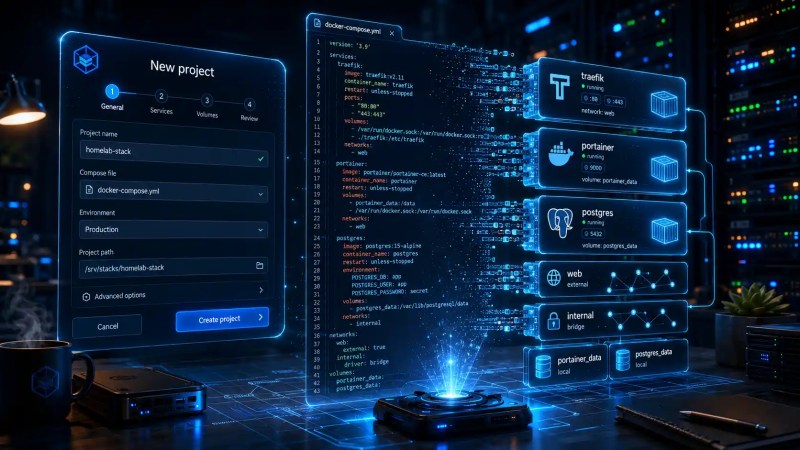
Create Docker Compose stack from scratch in Stashboard V7.4 — Add service, Raw YAML, or New project. Exact fields, how to verify, and the risks.
Update OpenMediaVault Without Losing Data: The Complete Safe Guide If you’ve been putting off updating your NAS because you’re afraid of what might happen to your files, this…
Stashboard V7.1 lets you edit Docker Compose without YAML from the browser — image, ports, volumes, env, labels and more — with atomic validated saves and comments preserved.
Stashboard’s visual docker compose editor self-hosted (V7.0–V7.7) lets you view, edit, diff, and apply docker-compose.yml from your browser — no YAML, no SSH, comments preserved.